Data-Driven AI Agents vs. Scripted Chatbots: Why Only One Actually Reduces Staffing
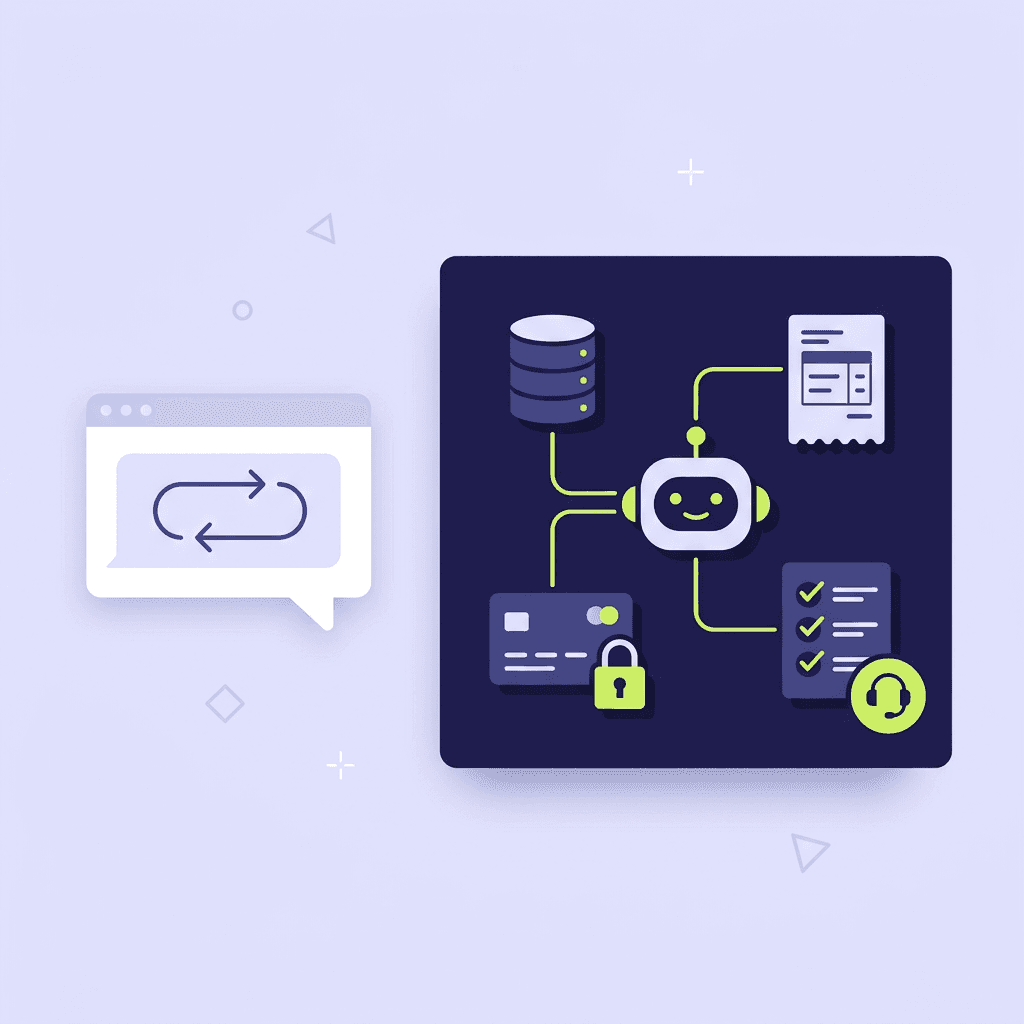
Many organizations have already tried a chatbot. It sits in the corner of the website, greets visitors, and answers a list of frequently asked questions. Yet the phones keep ringing, the inbox keeps filling, and the staffing plan looks the same as it did before launch.
The problem usually is not the technology's intelligence. It is the technology's reach. A chatbot that can only talk cannot finish the job, so the job still lands on a person.
The difference between a tool that answers and a tool that completes is the difference between a chatbot and a data-driven AI agent. Only one of them meaningfully reduces staffing demand.
Why most chatbots don't reduce workload
Look at what a typical inbound contact actually requires. A customer rarely wants a general explanation. They want to know their balance, confirm that a payment posted, change a due date, set up an arrangement, or pay right now.
A scripted or FAQ chatbot can describe how those things work. It cannot do them, because it has no secure connection to the customer's account and no permission to act. So the conversation ends with "please call our office" or "an agent will contact you." That is not automation. It is a delay in front of the same workload.
This creates three hidden costs:
- Repeat contacts: The customer tries the bot, then calls anyway, so one request becomes two interactions.
- Lost context: The employee who picks up starts from scratch, because the bot gathered nothing useful.
- False reporting: Dashboards count "conversations handled" even when the issue was never resolved.
If a tool cannot resolve the request, the only thing it removes is the customer's patience.
What makes an AI agent "data-driven"
A data-driven AI agent is defined less by its language model and more by what it is connected to and allowed to do. Four capabilities separate it from a chatbot.
1. It reads live account data
After verifying identity, the agent can retrieve the information the customer is asking about: current balance, recent payments, due dates, plan status, and account notes the organization chooses to expose. Answers come from the system of record, not from a generic script. ACM explains how billing data becomes that kind of conversation in its guide to personalized payment conversations.
2. It takes approved actions
This is the dividing line. A data-driven agent can accept a payment in a PCI DSS compliant environment, enroll an eligible account in an approved payment plan, record a promise to pay, schedule a callback, or update contact preferences. Each action follows rules the organization defines in advance.
3. It writes the result back
An action that never reaches the billing system creates more work, not less. The outcome must return through a remittance file or API so reminders stop, balances update, and employees see an accurate account.
4. It knows when to hand off
Disputes, hardship conversations, complaints, and anything outside the agent's authority should go to a person, with the verification status, account details, and conversation summary already attached. The employee resolves the issue instead of repeating the intake.
When all four are present, a large share of routine contacts can begin and end without staff involvement. When any one is missing, the work leaks back to the team.
The same agent, every channel
Customers do not think in channels. Someone might start on a website chat at night, receive a text reminder the next day, and call from their car that afternoon.
A data-driven approach uses one set of account data and one set of business rules behind every channel: web chat, text, and voice. The customer gets the same answer and the same options wherever they show up, and the organization maintains one policy instead of three. ACM's voice side of this model is covered in IVR payment processing with AI voice agents, and a real verify-and-pay chatbot flow is walked through in Easier Than MyChart.
Guardrails: how to let an AI agent act safely
Giving software the ability to act on accounts raises a fair question: what stops it from doing the wrong thing? The answer is to separate what the agent says from what the agent is permitted to do.
- Verify before disclosing. No account information is shared until the customer passes the organization's authentication rules.
- Act only through defined tools. The agent cannot invent a discount, waive a fee, or create a custom plan. It can only call the specific actions it has been given, with the limits attached to each.
- Ground answers in data. Account-specific answers should come from retrieved records, not from the model's general knowledge, which sharply reduces the risk of a confident but wrong reply.
- Keep payments out of the conversation. Card details belong in a secure payment form or tokenized flow, not in chat transcripts or call recordings.
- Log everything. Every verification, action, and transfer should be auditable so compliance and operations teams can review what happened.
- Respect contact rules. Outbound messages must follow consent, timing, disclosure, and jurisdictional requirements that apply to the organization and industry.
Well-designed guardrails are what make it reasonable to let an agent finish a transaction instead of escalating every request.
How to measure real staffing impact
"Number of chats" is the most common metric and the least useful. To understand whether an AI agent is reducing staffing demand, measure outcomes.
- Containment rate: The percentage of contacts fully resolved without an employee. Count only resolved requests, not conversations that simply ended.
- Repeat-contact rate: How many customers contact you again about the same issue within a few days. A rising number means the agent is deflecting rather than resolving.
- Transfer reasons: Why customers are routed to staff. Each recurring reason is either a legitimate human task or a gap the agent could close.
- Handle time after transfer: If context passes correctly, employees should resolve transferred cases faster than cold contacts.
- After-hours resolution: How much work is now completed at night and on weekends, when no staff is scheduled.
- Staff hours recovered: Resolved contacts multiplied by the average handle time each would have required from an employee.
That last figure is the honest measure of staffing impact. Here is a simple illustration. If an agent fully resolves 3,000 routine contacts per month that would each have taken an employee six minutes, it returns 300 staff hours per month, roughly the working time of almost two full-time employees. Actual results depend on contact mix, data quality, and design, but the math shows why resolution matters more than volume.
Where AI agents fit, and where people still win
AI agents are strongest at high-volume, rules-based work: verification, balance and status questions, payment capture, approved plans, confirmations, reminders, and callback scheduling.
People remain essential for judgment: disputes, hardship and sensitive situations, complex billing errors, escalated complaints, and relationship-critical accounts.
The goal is not to remove humans from the process. It is to stop using skilled employees for work a well-connected system can complete, so they can spend their time on the conversations that genuinely need them. For a broader look at how this changes call center planning, see ACM's guide to reducing call center staffing demands.
A buyer's checklist for AI agents and chatbots
Before choosing a solution, ask each vendor to demonstrate, not just describe, the following:
- Data access: Can it securely verify a customer and retrieve that customer's live account data?
- Actions: Which actions can it complete on its own, and where are the limits configured?
- Write-back: How are results written back to our billing system, and how quickly?
- Payment security: Is payment captured in a PCI DSS compliant environment outside the chat or call transcript?
- Handoff: What happens when a customer asks for a person, and what context transfers with them?
- Consistency: Does it use the same data and rules across chat, text, and voice?
- Reporting: Does it report containment, repeat contacts, and transfer reasons, not just conversation counts?
- Configuration: Can it be branded and configured to our policies without rebuilding our systems?
A solution that answers "no" to the first three is a chatbot. It may improve the website, but it will not change the staffing plan.
Put your data to work, not just your chatbot
The organizations that reduce staffing with AI are not the ones with the most impressive demo. They are the ones that connect the agent to their account data, give it clearly defined permissions, and measure resolved work instead of conversations.
Advanced Cash Management builds data-driven AI agents, chatbots, voice, IVR, and text solutions that integrate with existing billing systems and payment processors. Each solution is branded to the client, follows the client's rules, and hands off to staff with full context when a person is the right answer.
Want to see what share of your contacts an AI agent could resolve? Schedule a discovery call → or call (866) 240-2160.
Frequently asked questions
What is the difference between an AI agent and a chatbot? A traditional chatbot answers questions from a script or FAQ library. A data-driven AI agent connects to account systems, verifies the customer, retrieves their specific information, and completes approved actions such as taking a payment or setting up a payment plan. The agent resolves the request; the chatbot usually redirects it.
How do AI agents reduce staffing? They resolve routine, rules-based contacts end to end, including after hours, so those requests never reach an employee. When a person is needed, the agent transfers the customer with verification and account context, which shortens the employee's handling time as well.
What is a good chatbot containment rate? It depends on the contact mix and how many actions the agent is allowed to complete. The more important point is how containment is measured: only fully resolved contacts should count, and repeat contacts should be tracked so deflection is not mistaken for resolution.
Are AI agents safe to use with customer accounts? They can be when designed with strong guardrails: authentication before disclosure, actions limited to predefined tools, answers grounded in account data, secure PCI DSS compliant payment capture, full audit logs, and adherence to applicable consent and contact rules.
Will customers still be able to reach a person? They should. A well-designed agent transfers customers on request, when it reaches the limit of its permissions, or when a situation calls for human judgment, and it passes the context along so the customer does not have to start over.
Do we need to replace our billing system to use AI agents? Not typically. Data-driven agents are usually connected to existing billing systems and payment processors through APIs or file-based integrations. The right approach depends on the systems in place and how quickly account updates need to appear.
This article provides general business information and is not legal, compliance, or financial advice. Examples and calculations are illustrative. Results depend on contact mix, data quality, integrations, customer behavior, industry, and implementation.