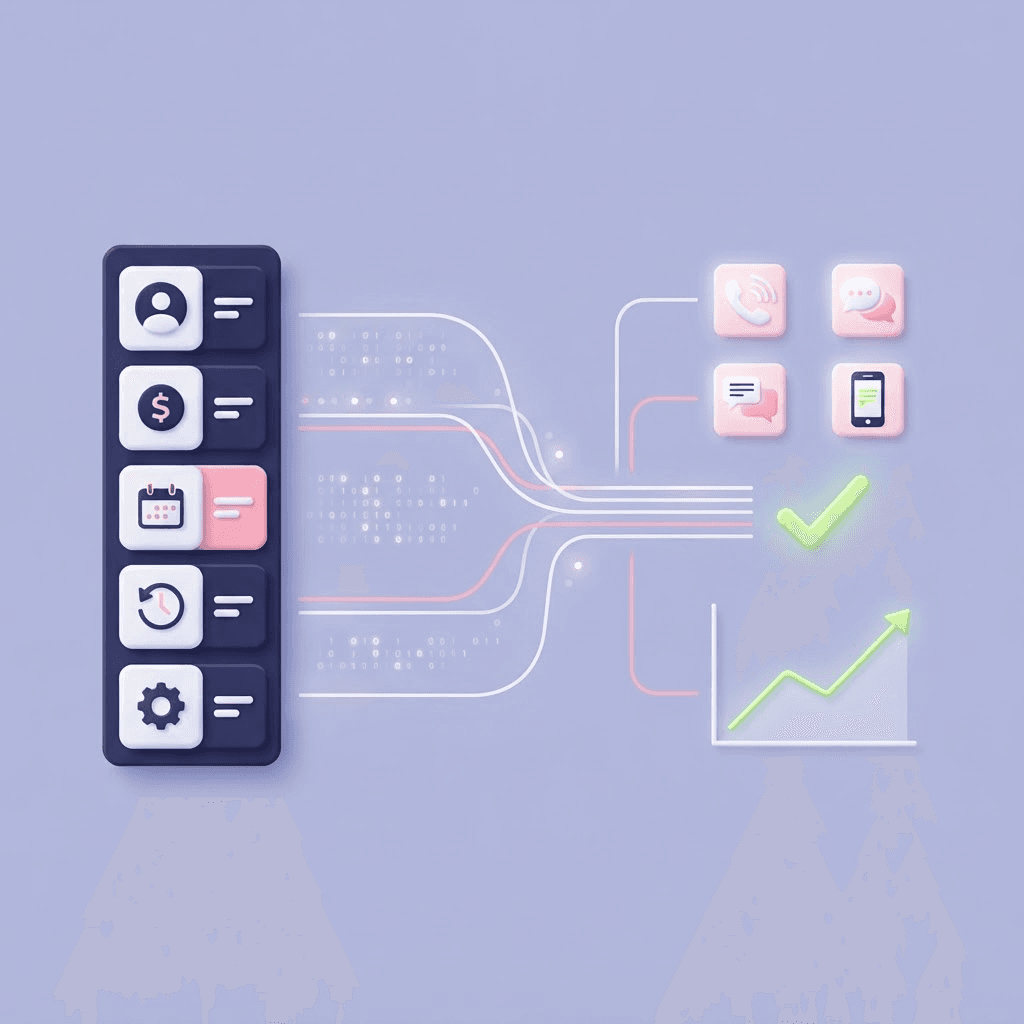
Most organizations already have the information needed to provide a better payment experience. Customer balances, billing details, payment history, insurance information, account status, and payment-plan eligibility are often available to internal representatives.
The problem is that this data usually becomes useful only after a customer reaches a live employee.
Advanced Cash Management changes that by integrating client billing data into IVR, chatbot, text messaging, and other automated dialogue solutions. This allows customers to receive detailed account information, make payments, arrange approved payment plans, and complete routine account activity without waiting for an employee.
By combining the same data internal agents use with carefully designed automated dialogue, ACM can provide a human-like customer experience 24 hours a day at a fraction of the cost of handling every interaction with live staff.
This is how customer data becomes a personalized payment conversation, and how that conversation can become revenue.
What is a personalized payment conversation?
A personalized payment conversation uses the customer's actual account information to determine what the system says, what options it offers, and what action the customer can take.
It is different from a generic payment reminder or a basic chatbot that provides the same response to every visitor.
For example, a generic message might tell a customer to visit a website or call a billing department.
A personalized payment conversation can securely identify the customer and provide information such as:
- Current account balance
- Individual billing details
- Payment history
- Insurance billing summaries
- Due dates
- Payment-plan options
- Available payment methods
- Recent account activity
The conversation can then guide the customer toward the appropriate next step, whether that is making a payment, reviewing account information, establishing an approved payment plan, or speaking with a representative.
ACM uses the same billing data available to internal agents
ACM typically receives a billing data extract that mirrors the information available to the client's internal customer service or revenue-cycle staff.
Depending on the client's systems and requirements, that information may be delivered through a secure file-transfer process or through a direct integration with the client's customer relationship management, billing, or account-management system.
The goal is to give ACM's automated dialogue solutions access to the information needed to handle many of the same routine conversations that would otherwise require a live employee.
When that data is combined with AI-driven dialogue, the system can respond based on the customer's specific account instead of relying on a fixed script or a limited menu.
A customer asking about a recent payment can receive payment-history information. A patient may be able to review an insurance billing summary. A customer with an eligible balance may be offered an approved payment plan. Another customer may simply want to confirm the amount due and complete a payment.
The experience changes according to the account data and what the customer is trying to accomplish.
Designing around what customers actually call about
After nearly two decades of IVR experience, ACM has learned that an effective automated system should not begin with the technology. It should begin with the customer's reason for calling.
Before designing a dialogue flow, ACM works to understand the most common goals customers have when they contact the organization.
Those goals may include:
- Checking a balance
- Understanding a bill
- Reviewing payment history
- Receiving insurance-related information
- Making a one-time payment
- Establishing a payment arrangement
- Confirming that a payment was received
- Requesting help from a representative
The dialogue is then designed around those needs.
This sounds simple, but it is where many automated systems fail. Organizations sometimes build IVR menus around internal departments, system categories, or technical processes rather than what the caller is trying to accomplish.
Customers should not need to understand how a company is organized in order to get an answer or make a payment.
ACM designs the flow around customer intent, making it easier for the caller to reach the right information and complete the desired action.
One set of data across voice, chat, and text
Customers do not all prefer the same communication channel.
Some customers are comfortable making a payment by telephone. Others prefer an online chatbot. Some are more likely to respond to a text message than to answer a call or navigate a website.
ACM can integrate client account data into multiple dialogue solutions, including:
- Interactive voice response
- AI-powered voice agents
- Web-based chatbots
- Text messaging
- Automated outbound communication
- Payment links and digital payment workflows
The same underlying billing data can support each channel.
This creates a more consistent experience. Customers can receive relevant account information and payment options regardless of whether they engage by phone, chat, or text.
It also prevents each communication channel from becoming a separate information silo.
A true multichannel payment strategy is not simply having an IVR, a chatbot, and a text-messaging platform. It requires those solutions to use accurate client data and support the same operational rules.
A practical example of a personalized payment conversation
Consider a healthcare organization that sends ACM a daily billing data extract.
The file may include the patient's balance, account status, payment history, insurance billing information, contact details, and eligibility for a payment arrangement.
When the patient contacts the payment IVR or chatbot, the system can securely access the appropriate account information.
The conversation may then proceed like this:
1. The patient completes the required identity-verification process. 2. The system provides the current balance and relevant billing information. 3. The patient asks for a summary of recent payments or insurance activity. 4. The system presents available payment options. 5. The patient makes a payment or selects an approved payment plan. 6. A confirmation is provided immediately. 7. The payment is reported back to the healthcare organization for posting.
The same general process can be adapted for utilities, insurance companies, cable providers, collection agencies, travel companies, and other organizations that manage customer balances and payments.
The terminology, account details, business rules, and available actions change by industry, but the core concept remains the same.
Customer data determines the conversation.
Knowing when to transfer to a live agent
Automation should make service easier. It should not prevent customers from getting help.
ACM can transfer a caller to a live representative when the customer asks to speak with someone or when the system detects that the customer is experiencing repeated errors.
This is an important part of the customer experience.
Some issues are better handled by an employee, including:
- Complex billing disputes
- Unusual account conditions
- Questions that fall outside the available data
- Repeated identification or input errors
- Customers who request personal assistance
- Situations requiring judgment or special approval
The objective is not to keep every customer inside an automated system at all costs.
The objective is to automate the routine interactions that technology can handle effectively and move the remaining conversations to the right person.
This gives customers faster access to everyday information while allowing employees to focus on situations where human involvement adds the most value.
Removing repetitive work from internal staff
A large percentage of billing and customer-service calls involve predictable requests.
Customers want to know what they owe. They want an explanation of recent account activity. They want to make a payment. They want to ask whether a payment plan is available.
When every one of these interactions requires an employee, staffing demands increase along with hold times, call volume, and operating costs.
ACM's dialogue solutions can automate many of the most repetitive tasks, including:
- Providing account and billing details
- Communicating payment history
- Accepting one-time payments
- Establishing approved payment plans
- Delivering payment confirmations
- Answering common account questions
- Routing customers who require additional assistance
This does not eliminate the need for skilled employees.
It reduces the number of routine interactions that consume their time, allowing them to concentrate on complex cases, exceptions, disputes, and customers who need individual attention.
Why 24/7 availability can increase revenue
One of the clearest advantages of automated payment conversations is availability.
Customers do not always think about a bill during normal business hours. They may review an account in the evening, receive a reminder over the weekend, or decide to make a payment when the billing office is closed.
A live call center cannot always be available at those times.
An automated IVR, chatbot, or text-based payment solution can provide account information and accept payments 24 hours a day.
This reduces the gap between the customer's decision to act and their ability to complete the payment.
Instead of asking the customer to call back later, wait for an employee, or remember to visit a separate payment page, the conversation can provide an immediate path to resolution.
Convenience alone does not guarantee payment, but unnecessary friction can prevent customers from completing payments they are otherwise ready to make.
Working with the client's existing payment processor
Organizations may assume that adding an automated payment solution requires replacing their current processor.
ACM is processor-agnostic.
The platform can integrate with a client's existing payment processor, allowing payments to continue flowing through the organization's established merchant relationship.
This provides several practical advantages:
- The client maintains its existing payment-processing arrangement.
- Funds remain available through the existing processor.
- The organization avoids an unnecessary processor conversion.
- ACM can focus on improving the customer conversation and payment workflow.
- Implementation can fit around the client's current technology environment.
ACM's role is to connect client data, customer dialogue, and payment activity. It does not require the client to replace systems that are already working effectively.
Returning payment information to the client
Accepting a payment is only part of the process. The transaction also needs to be reported and posted accurately to the customer's account.
ACM typically provides clients with a daily payment-remittance file that can be imported into their billing system for prompt posting.
For organizations that need a more immediate workflow, ACM can also integrate directly with the client's system through an API to support live payment posting.
The appropriate approach depends on the client's systems, operating requirements, and available integration options.
A daily remittance file may be sufficient for one organization. Another may require real-time updates.
ACM can design the reporting and posting process around the client's existing workflow rather than forcing every organization into the same integration model.
Common mistakes in automated payment systems
One of the most common mistakes ACM sees is making it too difficult for customers to enter or use the automated system.
This can happen when an IVR requires too much information, presents confusing instructions, uses long menus, or forces customers through unnecessary steps before they can accomplish a simple task.
Every additional obstacle creates another opportunity for the customer to disconnect.
An effective system should:
- Ask only for the information needed to securely continue
- Use clear and simple instructions
- Prioritize the most common customer goals
- Avoid long or complicated menu trees
- Confirm entries when appropriate
- Offer help when repeated errors occur
- Make live assistance available when needed
The best automated payment experience is not necessarily the one with the most features.
It is the one that helps the customer complete the desired task with the least unnecessary effort.
More than a payment link or basic chatbot
A payment link can be useful, but it is not the same as a personalized payment conversation.
A basic payment link sends every customer to essentially the same destination. It usually does not explain the balance, provide account history, answer billing questions, determine payment-plan eligibility, or adjust the experience based on client data.
Similarly, a basic chatbot may answer general questions without having access to the customer's actual account.
ACM's approach is different because client data is integrated into the payment solution.
That data allows the IVR, chatbot, voice agent, or text workflow to provide account-specific information and guide the customer toward an appropriate resolution.
The value is not simply the communication channel.
The value comes from combining accurate account data, intelligent dialogue, established business rules, payment processing, and payment reporting into one connected experience.
Industries that benefit from data-driven payment conversations
Personalized payment dialogue can be applied anywhere customers need account information or a convenient way to resolve a balance.
ACM's solutions can support organizations in industries such as:
- Healthcare
- Insurance
- Utilities
- Cable and telecommunications
- Collection agencies
- Travel
- Property management
- Financial services
- Government and public services
- Other account-based service organizations
Each industry has different terminology, compliance requirements, payment rules, and customer expectations.
That is why the conversation should be designed around the client's actual data and workflow rather than built from a generic template.
Turning data into dialogue and dialogue into revenue
Customer data becomes valuable when it helps a customer understand an account and take action.
By integrating billing data into IVR, chatbot, voice, and text-based payment solutions, ACM can provide many of the same details customers would receive from an internal representative.
Customers can review account information, make payments, establish approved payment plans, and request help through the channel they prefer.
Clients can provide service around the clock, reduce repetitive staff work, maintain their existing payment processor, and receive payment information through daily remittance files or real-time API integrations.
The result is a payment experience built around the customer's actual account rather than a generic script.
That is how data becomes dialogue, and dialogue becomes revenue.
Create more effective payment conversations with ACM
Advanced Cash Management combines nearly two decades of IVR experience with AI-driven voice, chatbot, text messaging, data integration, and payment automation.
ACM works with your existing customer data, payment processor, billing systems, and operational workflows to create personalized conversations that help customers understand their accounts and complete payments.
Contact Advanced Cash Management to learn how your billing data can support more effective customer dialogue, increased payment activity, and lower staffing demands. Schedule a discovery call or call (866) 240-2160.
Frequently asked questions
What is a personalized payment conversation? A personalized payment conversation uses the customer's actual account information—such as balance, billing details, payment history, insurance summaries, due dates, and payment-plan eligibility—to determine what the system says, what options it offers, and what action the customer can take, rather than delivering the same generic message to everyone.
How does ACM access the data behind these conversations? ACM typically receives a billing data extract that mirrors the information available to a client's internal customer service or revenue-cycle staff, delivered through a secure file-transfer process or a direct integration with the client's CRM, billing, or account-management system.
Which channels can deliver personalized payment conversations? The same underlying billing data can support interactive voice response, AI-powered voice agents, web-based chatbots, text messaging, automated outbound communication, and payment links or digital payment workflows.
Do I have to replace my current payment processor? No. ACM is processor-agnostic and can integrate with a client's existing payment processor, so payments continue to flow through the organization's established merchant relationship without an unnecessary processor conversion.
How are payments reported back for posting? ACM typically provides a daily payment-remittance file that can be imported into the client's billing system, and for organizations that need a more immediate workflow, ACM can integrate directly through an API to support live payment posting.
When does the system transfer a customer to a live agent? ACM can transfer a caller to a live representative when the customer asks to speak with someone or when the system detects repeated errors, so complex disputes, unusual account conditions, and situations requiring judgment reach the right person.
Which industries benefit from data-driven payment conversations? Healthcare, insurance, utilities, cable and telecommunications, collection agencies, travel, property management, financial services, government and public services, and other account-based service organizations can all apply personalized payment dialogue.