How to Reduce Call Center Staffing Demands Without Sacrificing Customer Service
Call centers are under pressure from several directions at once.
Organizations are dealing with rising labor costs, difficulty recruiting and retaining qualified employees, unpredictable call volume, and customers who expect immediate service. When staffing levels do not keep pace with demand, the results are often long hold times, abandoned calls, frustrated employees, and angry customers.
Adding more employees may appear to be the obvious solution, but hiring alone does not address the underlying problem. A significant portion of call center volume usually comes from repetitive account inquiries and payment-related tasks that can be handled effectively through automation.
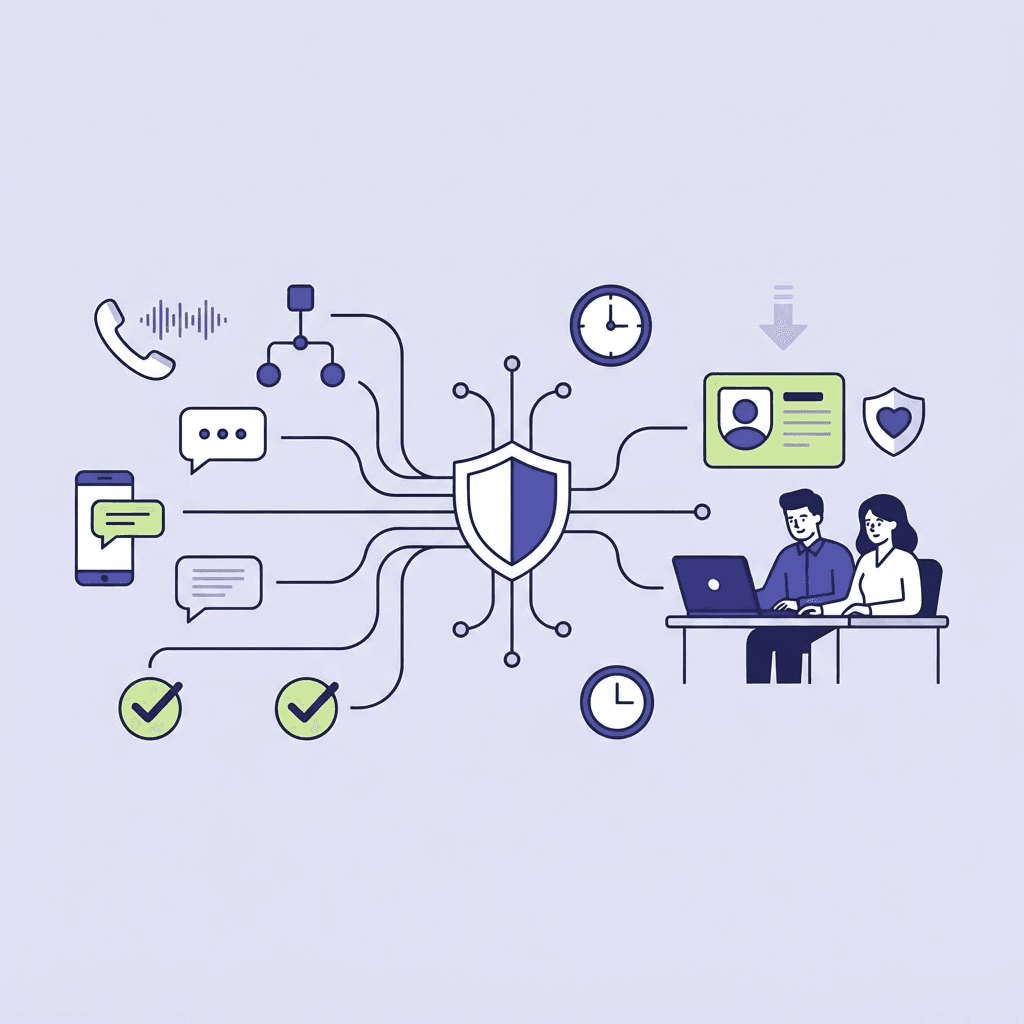
Advanced Cash Management helps organizations reduce staffing demands by integrating client data into customized IVR, AI voice, chatbot, and text-based solutions. With access to complete and accurate account data, ACM's digital agents can handle many of the same routine interactions managed by live employees while remaining available 24 hours a day.
The objective is not to remove people from customer service. It is to use automation for predictable, repetitive work so employees can focus on the situations that genuinely need human attention.
Which calls consume the most staff time?
Across healthcare, insurance, utilities, cable providers, collection agencies, travel companies, and other account-based organizations, many customer calls involve the same basic requests.
ACM has found that some of the most time-consuming interactions include:
- Balance inquiries
- Billing questions
- Payment processing
- Payment-plan requests
- Insurance-related questions
- Payment confirmations
- Account updates
- Requests for recent account activity
These calls are important, but many do not require the judgment, experience, or personal attention of a live employee.
A representative may spend several minutes authenticating the caller, opening an account, reviewing the balance, explaining recent transactions, taking a payment, and documenting the interaction. When the same process is repeated hundreds or thousands of times, routine calls consume a large portion of available staff capacity.
That can leave fewer employees available to handle disputes, complaints, exceptions, financial hardship cases, and complex billing issues.
Why hiring more employees is not always the best answer
Call center staffing problems are not limited to organizations trying to reduce headcount.
Many clients are trying to:
- Avoid adding employees as call volume increases
- Maintain service during employee turnover
- Reduce overtime
- Cover evenings, weekends, and holidays
- Manage temporary spikes in call activity
- Improve service without increasing labor costs
- Allow current employees to focus on more valuable work
Hiring additional representatives can be expensive and slow. New employees must be recruited, trained, supervised, scheduled, and retained. They may also require access to sensitive systems and ongoing education as billing rules, payment processes, and internal procedures change.
Even after increasing staff, organizations may still struggle during sudden call spikes or outside normal business hours. Automation provides a more flexible approach because capacity can be expanded without recreating the full cost and complexity of hiring additional employees.
Use reporting to understand when staffing pressure occurs
Before automating a call center, an organization should understand when and why customers are contacting it.
ACM's reporting can show when peak call periods occur, which types of calls are most common, where callers abandon the process, and which interactions most often require live assistance.
Peak periods may occur:
- After statements are delivered
- Near payment due dates
- Following an outbound campaign
- At the beginning or end of a billing cycle
- After an insurance adjustment
- During seasonal service changes
- On particular days of the week
- During certain hours of the day
This information allows the organization to make better staffing and automation decisions. For example, if reporting shows that call volume rises sharply after monthly statements are sent and that most callers simply want a balance or payment confirmation, those interactions can be prioritized for automation.
The goal is not to guess where automation might help. It is to use real call data to identify the greatest sources of avoidable staff demand.
What can an AI digital agent handle?
When ACM receives complete and accurate account data, its digital agents can handle up to 95% of the routine interactions a live agent may encounter. The exact percentage depends on the client's data, business rules, available integrations, and the complexity of its customer service environment.
A properly integrated digital agent may be able to:
- Authenticate the customer
- Provide a current account balance
- Explain billing details
- Review payment history
- Deliver insurance billing summaries
- Accept a one-time payment
- Establish an approved payment plan
- Confirm a completed or scheduled payment
- Update account information
- Send a secure payment link
- Answer common account questions
- Route the customer to the correct department
- Transfer the interaction to a live representative
This is significantly different from a traditional IVR that simply asks callers to press a number and move through a fixed menu. A data-driven digital agent can use the same information available to internal employees and adjust the conversation based on the customer's account and stated intent.
Start by understanding what the caller wants
One of the most important lessons ACM has learned through nearly two decades of IVR experience is that callers want to accomplish their task quickly and easily.
They do not want to learn how the organization is structured. They do not want to navigate a long list of departments. They do not want to listen to options that have nothing to do with the reason they called.
ACM begins the interaction by asking key initial questions designed to determine the caller's intent. For example, the digital agent may determine that the caller wants to:
- Make a payment
- Check a balance
- Ask about a bill
- Review insurance information
- Confirm a payment
- Request a payment arrangement
- Update an account
- Speak with a representative
Once the system understands the objective, it can guide the customer directly to the appropriate information or action. This intent-based approach reduces unnecessary steps and creates a more natural experience than a long menu tree.
Why traditional IVR systems frustrate customers
Automation damages customer service when it is designed around the technology rather than the caller. Common problems include:
- Long menu introductions
- Too many options
- Confusing instructions
- Requiring unnecessary information
- Repeating questions
- Sending customers to the wrong department
- Preventing access to a representative
- Failing to recognize what the caller is trying to do
- Providing generic answers without access to account data
These issues create the impression that the company is using automation simply to keep customers away from its employees. Effective automation should do the opposite. It should make common tasks faster while preserving a clear path to live assistance.
The measure of a successful digital agent is not how long it keeps someone inside an automated system. The measure is whether it helps the customer reach a satisfactory resolution.
Use client data to create a more human experience
One of the most common mistakes organizations make is failing to use the customer data they already have. A basic phone system or chatbot may be able to provide general instructions, but it cannot handle meaningful account questions unless it has access to billing and payment information.
ACM integrates client data into its digital payment and communication solutions. Depending on the client's environment, the system may use information such as:
- Current balance
- Statement details
- Payment history
- Insurance billing information
- Account status
- Payment-plan eligibility
- Approved payment-plan terms
- Recent account activity
- Available payment methods
- Customer contact information
- Internal routing rules
This allows the digital agent to provide an experience that closely reflects the type of interaction a customer would have with a knowledgeable employee. Instead of saying, "Please call the billing department," the agent may be able to explain the balance, review recent payments, present approved options, and complete the transaction during the same conversation.
Offer service after hours, on weekends, and during holidays
Customers do not limit account questions and payments to normal business hours. They may open a statement at night, remember a payment over the weekend, or respond to a reminder during a holiday when the call center is closed.
Without automation, those customers must wait, leave a message, or remember to call back later. ACM's digital agents can remain available 24 hours a day, including evenings, weekends, and holidays.
This reduces pressure on staff in several ways:
- Some customers complete transactions before the call center opens.
- After-hours inquiries do not automatically become next-day calls.
- Payments can be accepted when the customer is ready to act.
- Weekend and holiday coverage does not require full staffing.
- Customers receive service without waiting for normal office hours.
Twenty-four-hour availability can also improve revenue by reducing the delay between a customer's decision to pay and the opportunity to complete the transaction.
Know when automation should stop
A digital agent should never pretend to know something it cannot answer accurately. ACM's solutions can transfer customers to a live representative when:
- The customer requests an employee
- The system detects repeated errors
- The customer becomes confused
- The request falls outside the digital agent's available knowledge
- The account contains an unusual condition
- Special approval is required
- The digital agent determines that it is not qualified to resolve the issue
Any situation the system cannot handle confidently should be routed to an employee. Where the client's systems support it, ACM can also pass relevant account and interaction information to the live representative. This reduces the need for customers to start the entire process again after the transfer.
The customer should not have to repeat every answer simply because the conversation moved from automation to a person.
Let employees focus on work that requires human judgment
Reducing staffing demand does not mean that live employees become less important. It means their time becomes more valuable.
Once routine balance inquiries, payments, confirmations, and payment plans are automated, employees can focus on work such as:
- Resolving billing disputes
- Handling financial hardship situations
- Investigating unusual account activity
- Responding to complaints
- Correcting insurance or account errors
- Managing escalated cases
- Following up on high-priority accounts
- Assisting customers who need personal attention
- Completing other important operational tasks
These are areas where empathy, discretion, negotiation, and judgment matter. A live representative is far more valuable resolving a complicated account issue than repeatedly reading balances and taking routine payments.
Support inbound, outbound, chat, and text engagement
Call center demand cannot always be reduced through inbound automation alone. Some customers prefer to communicate by text or chat, while others respond more effectively to proactive outreach.
ACM can support a broader engagement strategy that includes:
- Inbound IVR
- AI voice agents
- Outbound calling
- Web chatbots
- Text messaging
- Secure payment links
- Automated payment reminders
- Live agent transfers
When these channels use the same underlying customer data and business rules, customers have more ways to resolve their accounts without placing a traditional service call. A customer who receives a text reminder may complete a payment through a secure link instead of calling. A website visitor may use a chatbot to review a balance. Another customer may call the IVR after business hours.
Every successfully completed digital interaction reduces avoidable demand on the live call center.
Customize the solution instead of forcing a template
ACM is not simply an IVR vendor or a company that installs an off-the-shelf chatbot. ACM's team includes programmers who customize each solution around the client's specific needs. That customization may include:
- The client's terminology
- Authentication requirements
- Billing data structure
- Payment-plan rules
- Payment processor
- Call-routing requirements
- Live-agent transfer procedures
- Industry-specific questions
- Reporting needs
- Payment posting requirements
- Communication channels
- Compliance requirements
Different organizations have different customers, workflows, systems, and service expectations. A healthcare provider may need to explain insurance activity and patient responsibility. A utility may need to discuss service status and due dates. A collection agency may need to manage payment arrangements. A travel company may need to handle balances related to reservations.
A generic script will not serve all of these situations effectively. Customized automation is more likely to reduce staffing demand because it is designed around the work the client's employees are actually performing.
Implement without replacing the existing payment processor
Call center automation should not require an organization to rebuild its entire payment environment. ACM is processor-agnostic and can integrate with the client's existing payment processor.
This means the organization can continue using its established payment relationship while ACM provides the dialogue, account access, payment workflow, and reporting. The client retains immediate access to funds through its existing processor, and the automation can be designed around systems already in place.
After ACM receives the client's data file and completes integration with the current payment processor, a solution can typically be implemented within approximately 30 days. The actual timeline depends on data quality, integration access, testing requirements, business rules, and the complexity of the requested solution.
Measure results through detailed reporting
An organization should not assume that automation is reducing staffing demands. It should be able to measure the impact. ACM's detailed reporting can help clients evaluate:
- Total interaction volume
- Peak call times
- Reasons customers make contact
- Automated completion rates
- Live-agent transfer rates
- Payment volume
- Payment-plan activity
- After-hours transactions
- Abandoned interactions
- Common customer errors
- Areas where dialogue should be improved
This information can show whether clients are handling more activity without adding staff and where further improvements may be available. Reporting also allows the digital experience to be refined over time. Insights from completed calls, unsuccessful interactions, customer questions, and transfer patterns can be used to improve dialogue and routing.
The system should not remain static while customer behavior changes.
Lower the cost of routine customer service
The cost of a digital agent is generally far lower than the cost of recruiting, training, scheduling, supervising, and retaining additional call center employees. The exact savings depend on the client's call volume, labor costs, automation rate, transaction activity, and selected ACM solution.
ACM can offer pricing structures aligned with actual usage, transaction volume, or measurable activity, depending on the service being provided. This gives organizations the ability to expand service capacity without committing to the full fixed cost of additional employees.
The financial benefit becomes especially significant when automation handles activity outside normal business hours or during peak periods that would otherwise require overtime or additional shifts.
Automation should improve service, not merely reduce costs
Reducing staffing expense is valuable, but it should not be the only goal. Poorly designed automation may lower costs in the short term while frustrating customers and damaging the organization's reputation.
The better objective is to create a service model in which:
- Routine questions are answered immediately
- Payments can be completed at any time
- Customers are guided quickly to the correct solution
- Live employees are available for complex matters
- Account information follows the customer during a transfer
- Reporting identifies areas for ongoing improvement
- Staff members are not overwhelmed by avoidable calls
When automation is built around customer intent and supported by accurate client data, service can improve even as staffing demands decline.
Reduce call center pressure with ACM
Advanced Cash Management combines nearly two decades of IVR experience with customized AI voice agents, chatbots, text communication, payment automation, and client data integration.
With complete account data, ACM's digital agents can handle up to 95% of many routine interactions managed by live employees. Customers can review account information, ask billing questions, make payments, establish approved payment plans, receive confirmations, and request live assistance when necessary.
ACM customizes every solution around the client's data, current payment processor, business rules, reporting requirements, and customer-service goals. The result is a more scalable service model that reduces hold times, supports customers 24 hours a day, lowers staffing demands, and allows employees to focus on the work that needs them most.
Ready to reduce call center pressure? Schedule a discovery call → or call (866) 240-2160.
Frequently asked questions
How much call volume can automation actually handle? With complete and accurate account data, ACM's digital agents can handle up to 95% of the routine interactions a live agent encounters — balance inquiries, billing questions, payments, payment plans, confirmations, and account updates. The exact rate depends on your data, business rules, integrations, and the complexity of your customer service environment.
Does reducing call center staffing mean cutting jobs? No. The goal is to move predictable, repetitive work to automation so your existing employees can focus on disputes, financial hardship cases, complaints, and other situations that require human judgment. Their time becomes more valuable, not less.
Will customers still be able to reach a live person? Yes. ACM routes customers to a live representative when they request one, when the system detects repeated errors, or when a request falls outside what the digital agent can confidently handle. Where systems support it, account and interaction context is passed along so the customer does not have to start over.
How is this different from a traditional IVR phone tree? A traditional IVR asks callers to press numbers through a fixed menu. ACM's data-driven digital agents determine the caller's intent first, then use the same account data your employees see to answer questions and complete transactions — adjusting the conversation to the customer instead of forcing them through a menu.
Do we have to replace our current payment processor? No. ACM is processor-agnostic and integrates with your existing payment processor, so you keep your established merchant relationship and immediate access to funds while ACM provides the dialogue, account access, payment workflow, and reporting.
How long does implementation take? After ACM receives your data file and completes integration with your current payment processor, a solution can typically be implemented within approximately 30 days. The timeline depends on data quality, integration access, testing, business rules, and solution complexity.
This article is general information about call center automation and customer service and is not legal or compliance advice. Automation rates, savings, and timelines depend on your data quality, call volume, labor costs, business rules, and implementation. Consult qualified counsel about obligations specific to your industry and jurisdiction.