Branded Pay-by-Text: Your Logo, a Secure Payment Link, and an IVR Callback That Does the Rest
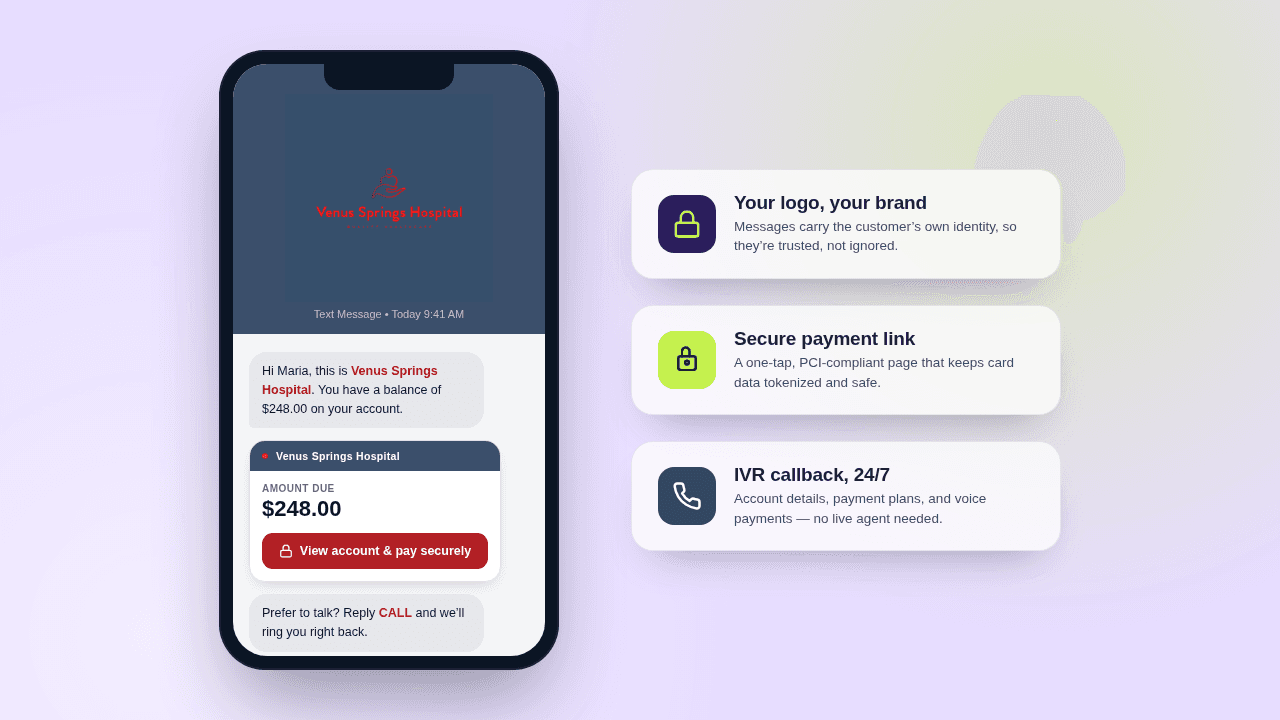
Picture the two texts a customer might get about a balance they owe.
The first is a bare link from a number they don't recognize: "Your account is past due. Click here to pay." No name, no logo, no context. To a careful person in 2026, that is indistinguishable from a phishing scam — and they're right to ignore it.
The second carries your company's name and logo, references the account in plain language, and offers a single secure link to a payment page that looks and feels like your business. If they'd rather talk it through, one tap requests a callback, and an intelligent voice system greets them by name, reads back their balance, and walks them through payment-plan options without a single minute on hold.
Same channel. Completely different outcome. The difference is branding, security, and giving the customer a real choice of how to resolve the balance — and that combination is exactly what a modern Pay-by-Text program is built to deliver.
Why "Pay-by-Text" only works when it's branded
Text messages get read. The open rates are genuinely staggering compared to email — most texts are opened within minutes, while the majority of billing emails are never opened at all. That's why so many businesses have rushed to add a "text to pay" option.
But the channel's greatest strength is also its weakness. Because SMS is so effective for reaching people, it's also the favorite tool of scammers, and consumers have learned to be suspicious. An unbranded payment text asks the customer to trust a stranger with their card number. Most won't.
Branding is what converts a suspicious message into a trusted one. When the text clearly comes from a business the customer already knows:
- Your company name appears as the sender identity
- Your logo and colors carry through to the payment page
- The message references the actual account — not a vague "you owe money"
- The link resolves to a domain consistent with your brand
Each of those signals answers the customer's first, instinctive question — is this real? — before they ever have to ask it. Trust is the entire ballgame in digital payments, and branding is how you earn it in the first three seconds.
The three pieces that make it work
A branded Pay-by-Text program isn't a single feature. It's three components working together, and each one removes a different point of friction.
1. The branded message
Everything starts with a message that looks like it came from you, because it did. It uses your business name, includes your logo where the customer's device supports rich messaging, and speaks in your voice rather than the flat tone of an automated dunning notice.
Critically, it's specific. A good message names the account, states the balance clearly, and gives the customer exactly one obvious next step. Vague messages create hesitation; specific messages create action.
2. The secure payment-site link
The link is the heart of the transaction, and it has to do two contradictory things at once: be effortless to use and be demonstrably secure.
Effortless means the customer taps once and lands on a payment page already associated with their account — no login maze, no hunting for an account number, no re-keying information you already have. Every extra step is a place where a motivated payer changes their mind.
Secure means the page is PCI-compliant and protects card data through tokenization, so sensitive numbers are never exposed or stored in the clear. The customer sees a page that carries your branding and obvious security cues; behind the scenes, the payment is processed to the highest compliance standard. That's the balance a real payment platform has to strike — a page that feels as simple as it is safe.
Because it's branded end to end, the experience never "breaks character." The customer moves from your text to your payment page to a confirmation, and at no point are they handed off to something that looks unfamiliar.
3. The IVR callback — the part most solutions skip
Here's where a serious platform separates itself from a simple "text to pay" button.
Not every customer wants to complete a payment on a web page. Some have questions. Some want to hear the numbers out loud. Some would simply rather talk. For them, the branded text offers a second path: request a callback, and an intelligent IVR — an interactive voice response system — calls them.
This isn't the maddening phone-tree of the past. A modern, AI-powered voice agent can:
- Greet the customer and authenticate them using the account tied to the message
- Read back full account details — current balance, due date, recent payments — on demand
- Offer and set up payment plans, walking through options conversationally instead of forcing a single lump-sum choice
- Take a payment by voice securely, then and there
- Answer common questions about the account without a live agent, 24/7
That last point matters more than it sounds. The callback works at 2 a.m. on a Sunday, which is exactly when many people finally sit down to deal with their bills. Offering self-service by both text and voice means you meet customers on whatever channel they're comfortable with, at whatever hour they choose — and every one of those interactions is one your team didn't have to staff.
This is the Digital Agent philosophy applied to the phone: a virtual agent that shares detailed account information and takes payments around the clock, so routine calls resolve themselves and your people are freed for the conversations that genuinely need a human.
What it looks like for the customer
Walk it through end to end and the appeal becomes obvious.
A customer receives a text with your logo: their auto-repair shop, their medical provider, their utility. It says the balance, names the account, and offers to help. They tap the link, land on a familiar-looking secure page, and pay in under a minute. Done.
Or: they have a question about the amount. Instead of the link, they tap "call me." Seconds later their phone rings, a friendly voice greets them, confirms who they are, and reads back the account. They ask about splitting it into three payments; the system sets up the plan and confirms the first date. They hang up having solved the whole thing without waiting on hold or explaining themselves to three different people.
Either way, the customer felt respected, in control, and safe — and you got paid faster.
What it looks like for your business
The customer-experience story is only half of it. The operational math is what makes Pay-by-Text worth adopting.
Faster cash flow. Payments that used to wait for a mailed check or a callback during business hours now happen the moment the text is read. Shortening the gap between billing and payment is the most direct lever you have on your revenue cycle.
Lower cost to collect. Every payment completed by self-service text or automated callback is a call your team didn't have to make and a piece of mail you didn't have to send. Staff time shifts from routine payment-taking to the exceptions that actually need judgment.
Higher contact and resolution rates. Because text reaches people that calls and letters miss, and because the callback option captures those who prefer to talk, more accounts get resolved and fewer age into serious delinquency.
Consistency and compliance. Automated outreach follows the same script every time and can be built to respect the consent and contact rules that govern messaging and calls, reducing the risk that comes with ad-hoc manual collections.
Brand protection. Every touchpoint stays in your name and your voice. Instead of a payment reminder that feels like an escalation, the customer experiences a convenient service — which protects the relationship you've already invested in building.
Where this fits with everything else
Branded Pay-by-Text is most powerful as part of an omnichannel approach rather than a bolt-on. The same account intelligence that powers the text can power a chat conversation, a web payment portal, and the IVR callback — so a customer can start in one channel and finish in another without losing their place.
That's the model we've built at Advanced Cash Management: Pay-by-Text and voice self-service running on the same PCI Level 1 payment platform, all under your brand, all sharing the same real-time account data. The customer sees one coherent business. You see one system doing the work of a much larger team.
Frequently asked questions
What is branded Pay-by-Text? Branded Pay-by-Text is an SMS payment method where the message carries your company's name and logo and links to a secure, brand-consistent payment page. The branding signals to the customer that the message is legitimate, which is what makes them willing to pay through it rather than dismissing it as spam.
Is paying by text message secure? Yes, when it's built on a compliant platform. The text itself only carries a link; the actual payment happens on a PCI-compliant page that protects card data through tokenization, so sensitive card numbers are never exposed or stored in the clear. Branding and a consistent domain also help customers confirm the request is genuine.
What does the IVR callback feature do? The IVR callback lets a customer request a phone call directly from the text message. An intelligent voice system then calls them, authenticates the account, and can read back full account details, set up payment plans, take a payment by voice, and answer common questions — 24/7, without a live agent.
Can customers set up a payment plan themselves? Yes. Both the payment page and the IVR callback can present payment-plan options and let the customer enroll on their own, without needing to reach a staff member during business hours.
How does Pay-by-Text speed up collections? Text messages are opened far faster and more often than emails or letters, so customers see the request almost immediately. Combined with a one-tap secure link and a self-service voice option, that removes the delays — mailed checks, phone tag, business-hours-only contact — that normally stretch out the time between billing and payment.
The bottom line
"Text to pay" as a bare link is a missed opportunity. Wrapped in your brand, backed by a secure payment site, and paired with an IVR callback that can surface account details and build payment plans on its own, it becomes something much more valuable: a self-service payment experience that customers actually trust and use — and one that gets you paid faster while protecting the relationship.
Want to see branded Pay-by-Text and IVR callback working together on your accounts? Advanced Cash Management will walk you through a live demo. Call 866-240-2160 or request a demo →.
This article is general information about payment and account-servicing practices and is not legal or compliance advice. Automated calls and text messages are regulated at the federal and state level, including consent requirements. Consult qualified counsel about your specific program.